Posts

Showing posts with the label non-fiction

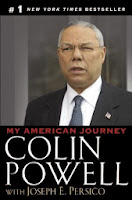
My American Journey

Image
My American Journey is Colin Powell’s autobiography, covering the years from his birth in 1937 to 1994, when he resigned as Chairman of the Joint Chiefs of Staff. Because of this time span, the book does not mention his later address to the UN Security Council, where he asserted that Iraq had developed mobile laboratories for producing biological weapons — a claim that later proved false and left him deeply humiliated. In my view, he should never have served under President George W. Bush alongside Dick Cheney and Donald Rumsfeld. Accepting the position of Secretary of State in the Bush administration was, I believe, the greatest mistake of his career. I do not know much about African American history or its many different backgrounds. Each individual has a distinct story. Condoleezza Rice is descended from enslaved Africans brought directly to America. President Obama is the son of a foreign student. Powell, by contrast, was the son of Jamaican immigrants. His parents came to the Un...

Dawkins Scale

Image
    I hesitate to call it a book; it’s more like a spectrum. In it, Richard Dawkins lays out seven milestones ranging from a fully committed theist to a fully committed atheist — a progression now known as the Dawkins Scale . 1. Strong theist. 100 per cent probability of God. In the words of C.G. Jung: "I do not believe, I know." 2. De facto theist. Very high probability but short of 100 per cent. "I don't know for certain, but I strongly believe in God and live my life on the assumption that he is there." 3. Leaning towards theism. Higher than 50 per cent but not very high. "I am very uncertain, but I am inclined to believe in God." 4. Completely impartial. Exactly 50 per cent. "God's existence and non-existence are exactly equiprobable." 5. Leaning towards atheism. Lower than 50 per cent but not very low. "I do not know whether God exists but I'm inclined to be skeptical." 6. De facto atheist. Very lo...

Consilience

Image
Edward O. Wilson is widely respected as a leading researcher on ants, biology, and biodiversity. He is also known as an ecologist and the father of sociobiology. I haven’t read Sociobiology , but I have read several of his other books— On Human Nature , Biophilia , and Naturalist . This book is difficult to read in a second language, but it is worth the effort, even if it takes time. At the beginning, reflecting on Einstein’s attempt to unify the physics of the micro and the macro, Wilson writes:   I found it a wonderful feeling not just to taste the unification metaphysics but also to be released from the confinement of fundamentalist religion. ・・・ science is religion liberated and writ large. ・・・Preferring a search for objective reality over revelation is another way of satisfying religious hunger.  (Chapter 1)   These words remind me of Spinoza . Later he writes: The greatest enterprise of the mind has always been and always will be the attempted linkage of the scienc...

Tuesdays with Morrie

Image
ALS, amyotrophic lateral sclerosis, is a progressive neurodegenerative disease that affects nerve cells in the brain and the spinal cord. It is also known as "Lou Gehrig's Disease". This is an incurable disease for now. ALS has affected many famous people including Lou Gehrig, Stephen Hawking, Mao Zedong, and also Torao Tokuda, Hideo Shinozawa in Japan. There are more than 8,000 patients in Japan. By the end, if you are still alive, you are breathing through a tube in a hole in your throat, while your soul, perfectly awake, is imprisoned inside a limp husk, perhaps able to blink, or cluck a tongue, like something from a science fiction movie, the man frozen inside his own flesh. This takes no more than five years from the day you contract the disease. (page 10 in this book) One day, Mitch Albom happens to know it on a TV news show, that his mentor, Morrie Schwartz, contracted ALS and is dying. He decided to pay a visit soon. They meet for the first time in sixteen...

Chasing the Flame

Image
 The UN plays an important role in resolving international conflicts and supporting refugees, but I realized I actually knew very little about its real activities. My understanding had mostly come from TV news and newspapers. This book is the biography of Sergio Vieira de Mello, who was killed in the 2003 Canal Hotel bombing while serving as the UN Secretary?General’s Special Representative in Iraq. The author is Samantha Power, a Pulitzer Prize?winning writer. Sergio was born in Brazil in 1948, the son of a Brazilian diplomat. He studied philosophy at the Sorbonne in Paris, where he joined the 1968 student protests. I’m from the same generation?slightly younger?and Japan experienced similar student movements at the time. In 1969, he found a job in Geneva as a French editor at the UNHCR, thanks to his exceptional language skills. From there, he went on to work in some of the world’s most difficult conflict zones?Rwanda, Lebanon, Cambodia, Yugoslavia, Kosovo, East Timor, and others...

The Girl in the Picture

Image
 The photograph of a naked little girl running down a road is one of the most iconic images of the Vietnam War. Taken by Nick Ut, it won the Pulitzer Prize in 1972. The girl in the picture is Kim Phuc, and The Girl in the Picture by Denise Chong tells her life story against the backdrop of modern Vietnamese history. Kim Phuc’s village was mistakenly bombed with napalm by the South Vietnamese air force under the direction of American military advisers. She suffered severe burns across her back. Nick Ut and other Western journalists rushed her to a hospital in Saigon, where her life was barely saved. After the war, the government used her as a propaganda symbol against American imperialism. Yet she dreamed of becoming a doctor so she could help people who suffered as she had. She also secretly held a Christian faith. Because Prime Minister Pham Van Dong cared for her like a granddaughter, she was allowed to study in Havana. In 1992, she married a fellow Vietnamese student, and durin...