Posts

An Artist of the Floating World

Image
An Artist of the Floating World , Kazuo Ishiguro’s second novel, was published in 1986 and shortlisted for the Man Booker Prize. His following novel went on to win the prize in 1989. Like A Pale View of Hills , this book again portrays a Japanese protagonist living in the aftermath of the war. Masuji Ono is a retired painter, and the story takes place around 1948 in postwar Japan. He gradually comes to realize that the failure of his younger daughter Noriko’s marriage negotiations stems from his own past. His elder daughter, Setsuko, hints at the same thing. As Ono reflects on his youth, his training, his teachers, colleagues, and pupils, the reader begins to sense that his recollections do not entirely match the memories of others. What exactly is Ono’s past? It becomes clear that he had supported Japan’s wartime ideology as an artist involved in propaganda. Ishiguro, of course, never states this directly, but allows it to emerge subtly through implication. During Noriko’s marriage m...

A Pale View of Hills

Image
A Pale View of Hills is Kazuo Ishiguro’s debut novel, published in 1982. I had never read his first two books before, so it was interesting to discover that he began his career by writing about Japanese people and postwar Japan. The story is set in Nagasaki around 1950, when people were still living with the wounds of the war and the atomic bombing, yet also sensing the coming changes of a new era. It is, in fact, the period when I was born. Etsuko, now living in England, has recently lost her elder daughter to suicide. In the wake of this tragedy, she looks back on her life in Nagasaki thirty years earlier, especially on her memories of her friend Sachiko and Sachiko’s daughter, Mariko. At that time, Etsuko was a virtuous, pregnant housewife, and her husband Jiro was a capable office worker. Jiro’s father, Ogata‑san, had come from Fukuoka to stay with them. Nearby lived Sachiko and Mariko in a small, run‑down house. Mariko, a quiet and withdrawn girl, often sees disturbing phantoms—...

Waterland

Image
Waterland is Graham Swift’s third novel, published in 1983. Although his Last Orders won the 1996 Booker Prize, many readers consider Waterland to be his finest work. The narrator, Tom Crick, is a fifty‑two‑year‑old history teacher whose wife has been arrested for abducting a baby. Living in Greenwich — the place where world time begins — he is being quietly pushed into retirement. He turns to his students and begins, “Children…,” launching a strange and unsettling series of history lessons. Tom speaks about the history of the Fens where he was born and raised, the story of his mother’s family, his youthful sexual experiences with Mary, his intellectually disabled brother Dick, the death of Freddie Parr, the French Revolution, the life cycle of eels, incest, abortion, madness, ghosts… Through this fragmented narrative, Swift explores the question of what history is , using a distinctly postmodern approach. The Fens of East Anglia were once a vast waterland. It was the Atkinson fami...

Jogging at night

I usually go jogging in the morning, and sometimes in the late afternoon on weekends, because I have to work on weekdays. As a result, I’ve gained a little weight recently due to lack of exercise. Last week, I started jogging at night every day. I can go out anytime between 8 p.m. and 10 p.m. This turned out to be a good idea for me, since I have solar photosensitivity and I’m busy on weekdays. It’s also nice that I can take a bath right after jogging. Of course, I have to watch out for traffic and for obstacles on the street that could make me twist my ankle. A few days ago, even though it was raining, I went jogging at night. According to the High‑resolution Precipitation Nowcasts from the Japan Meteorological Agency, the rain was supposed to stop for a while. But as soon as I started running, it began to rain harder. I ended up getting completely soaked that night.  

The Shadow of the Wind

Image
The Shadow of the Wind is a novel by the Spanish writer Carlos Ruiz Zafón, originally published in Spanish in 2001. It has since been translated into more than forty languages, published in over fifty countries, and, according to the author’s website, has sold more than twelve million copies worldwide. I read the English edition. In 1945, in post–Civil War Barcelona under Franco’s regime, ten‑year‑old Daniel Sempere is taken by his father to the secret Cemetery of Forgotten Books. There, Daniel is drawn to a novel titled The Shadow of the Wind and becomes fascinated by its mysterious author, Julián Carax. He reads the book quickly and is deeply moved. Daniel soon meets Clara, a beautiful twenty‑one‑year‑old blind woman who knows Carax’s works well, and he develops a romantic interest in her. One night, he encounters a faceless figure in the dark—Lain Coubert, the devil in Carax’s novel. The stranger offers Daniel a large sum of money for his copy of The Shadow of the Wind , intendin...

Eva Cassidy

Image
As I was listening to Emi Fujita’s songs on YouTube, I came across Eva Cassidy. Eva Cassidy is hardly known in Japan, and almost all of her CDs available here are imports. I had never heard her songs—or even her name—before. But her beautiful voice and remarkable musical sensitivity have the power to captivate listeners instantly. Eva Cassidy was born in Washington, D.C. in 1963 and grew up in Maryland. She had an interest in both art and music from childhood. When she was nine, her father began teaching her to play the guitar. At eleven, she joined a local band as a singer. In 1992, at the age of twenty‑nine, she released her first album, a duet album. Still, her name was known only in the Washington, D.C. area. In 1994, she was diagnosed with skin cancer. In 1996, Eva Cassidy passed away at the age of just thirty‑three. In 2000, the BBC broadcast her performance of Over the Rainbow , and it caused a sensation across Europe and eventually around the world. She became known as a legen...

Snow Falling on Cedars

Image
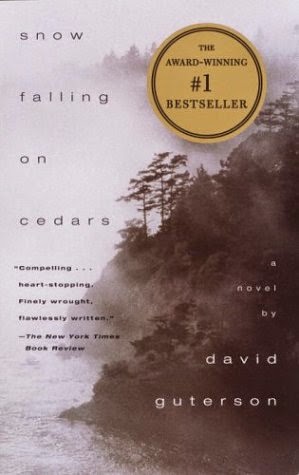
Snow Falling on Cedars is the bestselling novel David Guterson published in 1994, and it won the 1995 PEN/Faulkner Award for Fiction. The story was later adapted into a film of the same title. Because the defendant’s wife, Hatsue, was played by Yuki Kudoh, the movie attracted considerable attention in Japan. The novel was translated into Japanese in 1996, but the Japanese title, 殺人容疑 (“Suspicion of Murder”), felt disappointingly bland, and many Japanese readers were let down by it. The story takes place in December 1954 on a small island in northern Puget Sound, Washington State. Kabuo Miyamoto, a second‑generation Japanese‑American fisherman, is arrested on suspicion of murdering Carl Heine, another fisherman from the same community. A local journalist, Ishmael, watches the trial with complicated feelings. He once loved Hatsue when they were young. Their innocent relationship was torn apart after the attack on Pearl Harbor, when anti‑Japanese sentiment and racial prejudice overwhe...